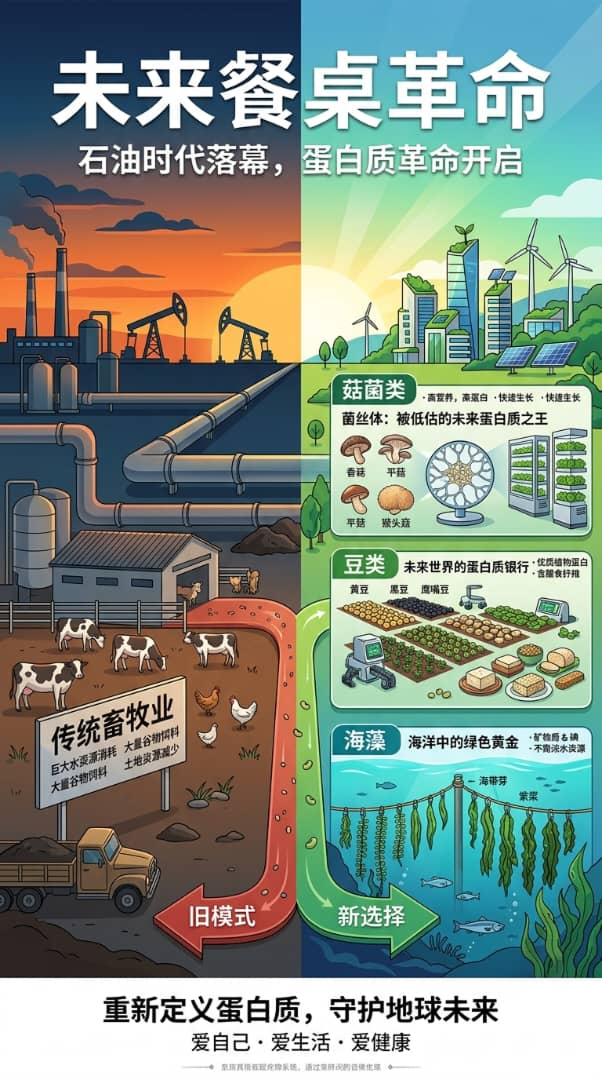
The Future Dining Revolution: As the Age of Oil Fades, Will Humanity Move Toward a Plant-Based World?
A Revolution Already Underway, Yet Rarely Noticed
Many people believe the greatest challenge of the future will be an economic crisis.
Others think it will be financial collapse, currency devaluation, or artificial intelligence replacing jobs.
Yet there is another, deeper and more fundamental challenge approaching—the global food crisis.
As the world's population continues to grow, arable land becomes increasingly limited and extreme climate events become more frequent, humanity is facing an important question:
Will we still be able to consume meat in unlimited quantities as we do today?
The answer may not be as optimistic as many expect.
Behind Every Piece of Meat Lies a Massive Consumption of Earth's Resources
Most people see steak, chicken, or lamb on their plates.
Few see the enormous resources required to produce them.
To produce just 1 kilogram of beef, significant amounts of the following are required:
Large quantities of water
Large quantities of grain feed
Extensive land use
Energy consumption
Transportation and logistics
Animals do not grow on their own. They consume vast amounts of corn, soybeans, grass, and other feed throughout their lives.
In other words:
Humans are not eating plants directly; they first feed plants to animals and then consume the animals.
During this process, a substantial amount of energy is lost.
If the same land were used to grow plant-based protein directly for human consumption, it could feed many more people.
This is why an increasing number of scientists are asking an important question:
Does humanity need to redefine what "protein" means in the future?
After the Oil Crisis, Food Security May Become the Next Global Challenge
Modern agriculture is heavily dependent on oil.
Oil is not only used for transportation but also for:
Agricultural machinery
Fertilizer production
Pesticide manufacturing
Cold-chain logistics
Food packaging
As energy costs rise, food costs inevitably increase as well. The future challenge may not simply be: "Can we afford food?" But rather: "Do we have enough resources to produce it?"
For this reason, countries around the world are investing heavily in research involving:
Plant proteins
Fungal proteins
Algae proteins
Cultivated proteins
All aimed at discovering more efficient and sustainable food sources for the future.
Mushrooms: The Underrated King of Future Protein
If there is one food that can offer:
✓ High nutrition ✓ High protein ✓ Low energy consumption ✓ Low carbon emissions ✓ Rapid growth
It may very well be mushrooms.
Shiitake mushrooms, oyster mushrooms, lion's mane mushrooms, king oyster mushrooms, and many others provide protein, dietary fiber, minerals, and beneficial polysaccharides.
More importantly, mushrooms do not require vast areas of farmland.
They can even be cultivated using wood chips and agricultural by-products.
Per unit of production area, their efficiency can greatly exceed that of traditional livestock farming.
For this reason, many scientists believe:
The "meat" of the future may not come from animals—it may come from fungi.
Mycelium: The Next Protein Revolution
The true power of fungi lies not only in the mushroom itself but in its underground network known as mycelium.
Mycelium naturally possesses a fibrous texture similar to animal meat.
With modern food technology,
it can be transformed into products that resemble:
Beef steaks
Chicken fillets
Burger patties
Meat floss
Meat chunks
In the future, the protein products found in supermarkets may come from mycelium farms rather than traditional ranches. This approach could dramatically reduce resource consumption and environmental impact.
Legumes: The Protein Bank of the Future
If mushrooms become the protein factories of tomorrow, then legumes are the protein banks.
Soybeans, black beans, chickpeas, red beans, tempeh, tofu, and other legumes have already proven their value as high-quality protein sources.
Many of the world's longest-living populations consume legumes regularly.
Phytochemicals
In addition to protein, legumes provide:
Dietary fiber,
Phytochemicals,
Essential nutrients
As global food demand continues to grow,
legumes will play an increasingly important role in feeding humanity.
The Green Gold of the Ocean: Seaweed and Marine Algae
The farms of the future may not be on land.
They may be in the oceans.
Seaweed varieties such as wakame, kelp, kombu, and nori grow rapidly and require little to no freshwater resources.
They are rich in:
Minerals
Iodine
Calcium
Magnesium
Antioxidants
Certain marine algae can even provide Omega-3 fatty acids, making them one of the most promising future superfoods.
A Plant-Based World Is Quietly Emerging
The future does not necessarily mean everyone will become a strict vegetarian.
However, the trend is becoming increasingly clear:
Less meat. Better protein. More plants. Smarter nutrition.
The proteins on future dining tables may come from:
✅ Mushrooms
✅ Mycelium proteinvIt Is About an Evolution of Consciousness
✅ Legume protein
✅ Algae protein
✅ Fermented protein
Traditional meat may gradually become a more expensive and less resource-efficient source of protein.
The Real Transformation Is Not Just About Food
It Is About an Evolution of Consciousness
In the past, humanity focused on:
Eating enough.
Later, the goal became:
Eating well.
In the future, the focus may be:
Eating healthily, sustainably, and wisely.
Future nutrition will not simply
be about satisfying hunger.
It will be about meeting our body's needs
while also caring for the planet, the environment, and future generations.
Love Yourself, and Love the World
The future food revolution
is not about deprivation.
It is about evolution.
It is not about restriction.
It is about choice.
When we learn to create greater value with fewer resources and nourish ourselves more intelligently, we not only improve our own health but also help protect the future of our planet.
Perhaps the greatest wealth of the future will not be measured by money.
It will be measured by:
A healthy body
A clear mind
The wisdom to live in harmony with nature
Because true abundance comes from
the balance and flow of life energy.
Love Yourself. Love Life. Love Health.
Perhaps this will become one of the most important survival wisdoms of the future age.